92% of Finance Professionals Want Flexible Work: How Competitive Is Your Model?

Samantha Coopman • 1 July 2026

Since the pandemic, petrol price increases, traffic, mental health concerns have all reshaped employee expectations, flexible work has now moved from a workplace preference to a serious talent strategy issue in talent acquisition and hiring.

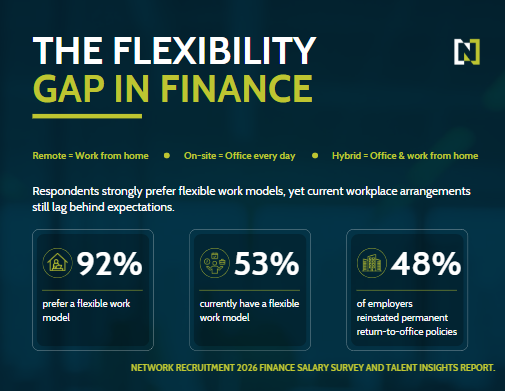
According to our Network Recruitment 2026 Finance Salary Survey & Talent Trends Report, 92% of finance professionals prefer a flexible work model, yet only 53% currently have one. This creates a 39-percentage-point gap between what finance professionals want and what many employers currently offer.


For finance leaders, this is no longer simply a question of office attendance. It has become a question of competitiveness, retention and whether your employee value proposition is aligned with the market.

South African Finance Professional Salary report and Talent insights

The flexibility gap in finance


The data shows that finance professionals are not necessarily asking for fully remote roles. The strongest preference is for hybrid work.


These figures come from three separate survey questions: preferred work model, current work model and return-to-office policy. Together, they highlight the gap between what finance professionals want and what many workplaces currently offer.


Download the guide by clicking on the image.
South African Finance Professional Salary report and Talent insights

The flexibility gap in finance

The data shows that finance professionals are not necessarily asking for fully remote roles. The strongest preference is for hybrid work.


These figures come from three separate survey questions: preferred work model, current work model and return-to-office policy. Together, they highlight the gap between what finance professionals want and what many workplaces currently offer.


Hybrid is the clear preference

The report shows that 72% of finance professionals prefer a hybrid model, compared with only 44% who currently have one. At the same time, 47% of finance professionals are currently on-site, while only 8% prefer to be fully office-based. [1]


The insight is clear: hybrid work has become the strongest middle ground. It gives employers structure, collaboration and visibility, while giving finance professionals the flexibility they increasingly expect.

Why this matters for hiring and retention

Global workforce research supports the same argument. Randstad’s 2025 Workmonitor found that work-life balance has overtaken pay as the top priority for workers globally, and almost a third of respondents said they had left a job because it did not offer enough flexibility. [2]

Similarly, a 2025 Hays survey reported that nearly half of UK professionals would consider resigning if required to return to the office full-time. While this is not South Africa-specific, it reflects a broader professional workforce trend that finance employers cannot ignore. [3]

In finance, where specialised skills are difficult to replace and hiring cycles can be lengthy, flexibility can directly influence:

  • offer acceptance
  • retention
  • employee engagement
  • commuting pressure
  • burnout risk
  • employer competitiveness

What a competitive flexibility model looks like

A competitive model means creating a win-win solution for you and your employee and often strongest approach is usually a role-based hybrid model.

Recent workplace research suggests that a balanced hybrid rhythm can support the brand as an employer, retention and career progression, particularly when it is structured and clearly managed to mitigate the risks involved. [5]

Table: Comparing finance work models

Work model Best suited for Employer risk
Fully on-site Highly regulated, operational or training-heavy roles May reduce candidate appeal and increase retention risk
Hybrid fixed days Most finance, accounting and reporting roles Can become rigid if office days lack purpose
Purpose-led hybrid Senior finance, FP&A, business partnering and project roles Requires strong management discipline
Fully remote Scarce skills, systems, data or specialist roles Can weaken onboarding and team connection if poorly managed

The key is not simply offering flexibility. It is designing flexibility properly.

Hybrid Models The Set-up The Benefit The Challenge
Flexible Hybrid (At-Will) The setup: Employees choose when and where they want to work on any given day. The benefit: Grants ultimate autonomy, making it highly desirable for employee retention. The challenge: Makes it difficult for teams to predict in-office attendance and plan collaborative events.
Fixed Hybrid (Split-Week) The setup: Management mandates specific days for in-office attendance (e.g., Tuesday through Thursday). The benefit: Ensures the entire team is co-located on specific days for deep collaboration and relationship building. The challenge: Reduces schedule flexibility compared to "at-will" options.
Team-Led Hybrid The setup: Individual team managers decide the in-office schedule based on project milestones and specific tasks, rather than a company-wide mandate. The benefit: Highly adaptable to the actual workflows of different departments (e.g., Marketing vs. Finance). Minimal
Remote-First The organisation primarily operates outside the physical office. Offices are treated as hubs for occasional meetings, brainstorming, or onboarding. Drastically reduces overhead costs for physical real estate. Highly reliant on robust digital collaboration tools and intentional virtual culture-building.
Office-First The office is the default workspace. Employees are expected on-site most of the week, with the option to work remotely for 1-2 days. Preserves traditional company culture, facilitates mentorship, and provides a structured daily routine. Minimal
Rotational Employees or departments take turns using the physical office in shifts (e.g., Team A comes in the first week of the month, Team B the second). Highly useful for companies with smaller offices or hot-desking models. Minimal

Download the report

Interested in learning more about what is in our report? Download it now by clicking on the button below

Download My Report


Bibliography

[1] Network Finance 2026 Finance Salary Survey & Talent Trends Report — flexible work preference, current access, and current vs preferred work models.

[2] Randstad’s 2025 Workmonitor, reported by The Guardian, found work-life balance had overtaken pay globally, and 31% had left a job due to insufficient flexibility.

[3] Hays 2025 survey, reported by The Guardian, found 48% of UK professionals would consider resigning if required to return to the office full-time.

[4] Reuters reported that Citi retained a hybrid model in 2025, allowing most employees to work remotely at least two days per week, positioning flexibility as a competitive advantage.

[5] A 2025 study on hybrid-work frequency found that approximately two remote days per week may balance lower turnover risk with stronger promotion outcomes.

FAQs

  • Why does flexible work matter in finance hiring?

    Flexible work matters because it directly affects how finance professionals evaluate opportunities. It can influence offer acceptance, retention, commuting pressure, work-life balance and overall employer attractiveness.

  • Does flexible work mean fully remote work?

    No. The strongest preference among finance professionals is hybrid work, not fully remote work. This suggests that many professionals still value office connection, but want more flexibility in how and where work is done.

  • What is the biggest gap in the finance work model data?

    The biggest gap is between flexible work preference and actual access. While 92% of finance professionals prefer flexibility, only 53% currently have a flexible work model.

  • Is hybrid work suitable for all finance roles?

    Not always. Some finance roles require more office presence due to operational, regulatory, stakeholder or training requirements. However, many finance roles can operate effectively within a structured hybrid model.

  • How can employers make hybrid work more effective?

    Employers should define clear office days, use in-person time for collaboration and coaching, set expectations around month-end or audit periods, and measure performance by outcomes rather than attendance alone.

  • What should hiring managers communicate to candidates?

    Hiring managers should be clear about the real work model from the start. Candidates want to know how many office days are expected, whether flexibility changes during reporting cycles, and whether the model is consistently applied across the team.

Add your title here

This is a paragraph. Make sure the title suits the content of this text.

Book now
by Riette Visser 2 December 2025
What hiring managers need know when hiring a graduate because remember that for a graduate, this is their first step into the world of work.
Network Engineering team working - recruit engineers
by Riette Visser 17 October 2025
Understand what drives engineers to stay long-term. From growth and recognition to culture and leadership. Build teams that thrive and actually want to stay.